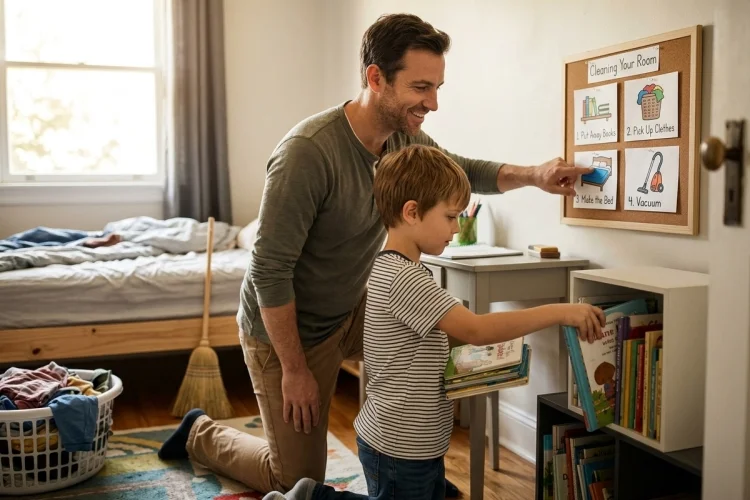
“Clean your room” sounds like a simple request, but it can actually involve dozens of decisions. Where should the clothes go? What happens to the books? Should the bed be made first? Which cleaning supplies are needed?
For someone who is still developing organization and daily living skills, a broad instruction like this can quickly become overwhelming.
Learning how to teach household chores in clear, manageable steps means turning large tasks into smaller actions that can be demonstrated, practiced, and eventually completed independently.
Household responsibilities can include making a bed, clearing a table, sorting laundry, washing dishes, sweeping floors, organizing belongings, or helping prepare meals.
The American Academy of Pediatrics notes that age-appropriate household responsibilities can help children develop practical life skills, responsibility, cooperation, and confidence.
The goal is not perfect housekeeping. It is helping learners understand how everyday tasks work and giving them enough structured practice to take greater responsibility over time.
1. Choose a Chore That Matches the Learner
Start with a task the learner has a realistic chance of completing.
Someone who has never done household chores independently may find “clean the entire kitchen” far too complicated. A better starting point could be clearing dishes from the table or putting clean cutlery into a drawer.
The American Academy of Pediatrics recommends introducing responsibilities gradually and taking individual abilities into account rather than expecting every child of the same age to perform identical tasks.
Think about physical ability, attention, reading skills, coordination, safety awareness, and previous experience.
A younger learner might put toys away, place dirty clothing in a laundry basket, or help set the table. An older learner may be ready to vacuum, wash dishes, do laundry, prepare simple food, or clean shared spaces.
The best first chore is usually useful, achievable, and easy to practice regularly.
2. Break the Chore Into Small Steps
One of the most effective ways to teach a household task is task analysis.
Task analysis means breaking a complicated activity into smaller individual actions that can be taught in sequence. It is widely used for teaching daily living skills, including cleaning, preparing food, dressing, and household chores.
Take clearing the dinner table.
Instead of saying, “Clear everything up,” teach:
- Pick up the plates.
- Scrape leftover food into the bin.
- Put the plates near or in the dishwasher.
- Collect the cups.
- Put away anything that belongs in the refrigerator.
- Wipe the table.
Now the learner knows what “clear the table” actually means.
Understood similarly recommends breaking chores into smaller chunks with a clear beginning, middle, and end.
If one step remains difficult, teach that part separately before expecting the learner to complete the entire sequence.
3. Show the Task Before Expecting Independence
Verbal explanations are useful, but demonstrations can make instructions much clearer.
Instead of explaining how to fold a towel for several minutes, pick one up and show the learner.
You might say:
“First, put it flat. Match these two corners. Fold it once. Now fold it again.”
Then do another towel together.
After that, let the learner try independently.
A simple teaching sequence is:
Show → Do Together → Learner Tries → Give Feedback → Practice Again
Keep your demonstration consistent, especially while the task is new. Constantly changing the method can make the routine harder to remember.
Avoid jumping in immediately when the learner makes a small mistake. Give them a chance to notice the problem and correct it.
The aim is to teach problem-solving as well as chore completion.
4. Use Visual Checklists for Multi-Step Chores
Some learners understand a task while an adult is explaining it but forget several steps once they begin.
Visual checklists can reduce this memory demand.
For washing dishes, a checklist might show:
Scrape plate → Rinse → Wash → Rinse again → Dry or rack → Put away
For bedroom cleaning:
Dirty clothes in basket → Make bed → Put books away → Put rubbish in bin → Organize desk
Picture schedules and visual planners can help learners remember the sequence of daily routines, particularly when organization and working memory are difficult.
Make the checklist match the learner’s abilities.
Someone who does not read comfortably may benefit from photographs or simple pictures. An older learner might prefer a short checklist on a phone.
Visual support should make the chore easier—not make the learner feel younger than they are.
5. Teach One New Chore at a Time
Giving someone ten new household responsibilities on Monday is usually not a great strategy.
Introduce one skill, practice it repeatedly, and then add another.
The American Academy of Pediatrics recommends introducing new responsibilities gradually because a long list can become overwhelming, especially when someone is not yet used to household duties.
Suppose the long-term goal is independent laundry.
Week one might focus only on putting dirty clothing into the correct basket.
Next, the learner could practice separating light and dark clothing if that distinction is relevant to the household routine.
Later, they might learn how to load the machine, measure the appropriate laundry product, choose the correct setting, move clothing to the dryer or drying area, fold items, and put them away.
The complete skill grows from several manageable pieces.
6. Make Chores Part of a Predictable Routine
Skills become habits when learners use them regularly.
Rather than randomly saying, “You need to vacuum today,” connect responsibilities to predictable times or events.
For example:
After dinner → Clear table
Saturday morning → Change bedding
After school → Put shoes and bag away
Tuesday evening → Take rubbish out
Consistent chore routines can make responsibilities easier to remember.
The American Academy of Pediatrics recommends building household responsibilities into regular family routines, while Understood suggests using schedules and chore charts for learners who find organization difficult.
A simple weekly chore chart can help too.
The learner sees what needs to happen rather than waiting for someone to remind them repeatedly.
Eventually, the routine itself becomes the prompt.
7. Teach Cleaning Product Safety Explicitly
Some household chores involve real safety risks, so independence should develop alongside safety awareness.
Do not assume a learner automatically knows that different cleaning products should not be combined.
The CDC advises following cleaning-product labels, ensuring appropriate ventilation when necessary, and never mixing cleaning or disinfecting products together. Cleaning chemicals should also be stored safely away from children and pets.
Teach specific rules rather than saying only, “Be careful.”
For example:
“Use only this cleaner for the table.”
“Never mix two cleaning liquids.”
“Wash your hands after using this product.”
“Ask before using an unfamiliar cleaner.”
For younger learners or anyone who cannot safely manage cleaning chemicals independently, choose chores that do not require hazardous products or maintain appropriate adult supervision.
Safety is part of learning the chore, not an extra lesson added afterward.
8. Give Specific Feedback Instead of Redoing Everything
It can be tempting to redo a chore immediately when the result is not perfect.
The bed may be slightly uneven. A towel may be folded differently. One corner of the table might still need wiping.
If adults silently redo every task, however, the learner may conclude that their effort is never good enough.
Give specific feedback instead.
“You put all the dishes away correctly. Check the table again-there is still one wet area near the corner.”
Or:
“You sorted the clothes well. This shirt belongs in the other pile.”
The American Academy of Pediatrics recommends realistic expectations and praise for effort while learners develop household responsibilities.
Focus on the parts that matter.
Safety and hygiene may require clear standards. Whether every pillow is positioned exactly as an adult prefers usually does not.
9. Gradually Reduce Reminders and Assistance
A successful chore routine should eventually require less adult involvement.
At first, an adult might stand beside the learner and explain every step.
Later, support could become:
“Check your chore list.”
After more practice, even that reminder may disappear.
This process is sometimes described as prompt fading—reducing assistance as the learner becomes more competent.
Track progress by noticing how much support is needed.
For example:
Week 1: five verbal prompts
Week 3: two verbal prompts
Week 5: uses checklist independently
That is meaningful progress even if the final cleaning result has not changed dramatically.
Independence also does not mean completing everything from memory. Adults use calendars, shopping lists, reminders, and cleaning checklists all the time.
A learner who independently follows a visual chore list is already demonstrating independence.
10. Connect Chores With Real-Life Independence
Household chores are not simply ways to make children or learners help adults.
They are practical life skills.
Knowing how to wash clothing, prepare a simple meal, clean a living space, manage rubbish, organize belongings, and care for household items becomes increasingly important in adulthood.
The American Academy of Pediatrics emphasizes that household responsibilities help develop life skills and a sense of contribution to shared family life. Chores remain useful throughout adolescence as young people prepare for greater independence.
Talk about that purpose.
Instead of:
“You have to do laundry because I said so,”
try:
“Learning this means you will be able to take care of your own clothes.”
That changes the chore from an arbitrary demand into a useful ability.
Learning how to teach household chores in clear, manageable steps starts with choosing an appropriate task and breaking it into actions the learner can understand.
Model the chore first, practice together, and use visual checklists when needed. Build responsibilities into predictable routines, teach safety explicitly, and give specific feedback instead of expecting perfection immediately.
Most importantly, reduce prompts as skills improve. The goal is not to create someone who follows adult instructions forever—it is to develop a person who knows how to manage everyday responsibilities with increasing independence.
Choose one household task this week. Write down every step, remove anything unnecessary, demonstrate the sequence, and let the learner practice it repeatedly. Mastering one small routine can become the foundation for much bigger daily living skills.